|
|
|
|
St Barths Bucket - 2010 Race Details
Announcement of Regatta
Sailing Instructions
Bucket Rating Rule
Superyacht Racing Protocol
Race Courses
Sample Application
Announcement of Regatta
St Barthelemy Bucket
March 25-28, 2010
The St. Barth’s Bucket is an invitational regatta set in the Corinthian spirit. The regatta is open to yachts over 100’ (31 M) L.O.A., unless invited under the Grandfather Clause. Yachts participating will do so at their own risk. This is a fun regatta and safety is the highest priority of the Race Committee. Therefore, we extend an invitation to the owners, captains, crews and guests who participate to make this a fun and safe event.
Event Organizers
The St. Barth’s Bucket is organized by The Bucket Association, St. Barth’s, FWI
The event is affiliated with and sanctioned by the Federation Francais de Voile (FFV).
Eligibility
The St. Barth’s Bucket Regatta is an invitational event, open to sailing yachts over 100’. Considering the unprecidented level of interest in the Bucket Regattas in recent years, the invitational aspect of the event has become increasingly relevant. With the Regatta often over-subscribed it is important for all applicants to understand the basis upon which entrants are selected. The invitation matrix is comprised of many factors including the yacht’s size and past participation, with major credit for contributions to the spirit of the event (the fun factor), and the crew’s understanding that Bucket Regattas are primarily about camaraderie and sharing the exhilaration of sailing these magnificent yachts to their potential in a competitive, yet seamanlike manner. This event is focused upon the yacht Owners; hence chartered yachts receive low priority.
Applications
A generic, provisional event and rating application form will be posted on the bucketregattas.com website for information purposes only. This application should be used only as a reference only and should not be submitted.
Official applications for the St. Barth’s Bucket Regatta will be available approximately five months prior to the event. To obtain an application, and/or to advise the Bucket Committee of your intention to enter the Regatta, contact the Committee at lisa@bucketregattas.com. We will add your yacht to the provisional entry list and will send out official applications as they are ready for distribution.
Sailing Rules
The St. Barth’s Bucket will be sailed under the Superyacht Racing Protocol, version 3.
In recognition of the fact that the yachts participating in Bucket events are too large and too constrained in their ability to maneuver, to be safely governed by the traditional Sailing Rules, the Superyacht Racing Protocol is a variation on the COLREGS, the International Regulations for Avoiding Collisions at Sea. A copy of the Superyacht Racing Protocol will be distributed to each yacht officially entered in the 2010 St. Barths Bucket, on or before 15 January 2010, via email. Well-considered comments on any aspect of the Protocol are absolutely encouraged. The Protocol is rapidly evolving into an effective set of safety rules and guidelines that recognize the handling limitations of the superyacht fleet. The Protocol will also be distributed at Registration and is available here.
All Rules of the FFV must also be respected and followed by all Bucket participants. This specifically includes the requirements for French citizens sailing in the regatta, to be holders of a current FFV Sailing License. Also, each yacht is required to maintain €1,500,000 liability insurance. Both requirements will be documented on the Crew Afadavit, to be completed by each participating yacht, at registration.
Sailing Instructions
Official event Sailing Instructions will be distributed at registration. Provisional Sailing Instructions, course descriptions and diagrams will be available on the Bucket Website on or before 15 January 2010.
Ratings and Scoring
Ratings and therefore start times will be assigned using the Bucket Rule. This is a VPP (Velocity Prediction Program) Rule administered by Jim Teeters of the Sailing Yacht Research Foundation (SYRF), and the Bucket Organization. For all contestants, it is of major importance to record the information requested on the Event Application as accurately as possible. This is the primary input data available for your performance analysis and all is easily obtained from your yacht designer, sailmaker or other marine consultants. For a complete description of the Bucket Rule and its application is available here.
Scoring will be by the low point system.
Classes
In 2005, when the Bucket Regatta grew beyond all expectations and the fleet doubled in size, it was determined that the fleet should be split into classes which considered their essential attributes. However, the distinction of “Cruising Class” and Racing Class” seemed just, oh so pedestrian, for a fleet of this stature. In the RC’s opinion, the designation of Les Gazelles des Mers” for the Racing Class and “Les Grandes Dames des Mers” for the Cruising Class, seemed far more appropriate. Both classes sail together on the same course, with awards for each division, and for the Bucket Overall Trophies as well.
Captain’s Meeting
The Captain’s Meeting will be held at 1700 on 25 March 2010. Location to be announced. Sailing instructions and the Superyacht Racing Protocol will be distributed via email, prior to the Captains Meeting, with additional copies available at the meeting. Course diagrams, safety considerations and other regatta related information will be also distributed at that time.
At minimum, each yacht must be represented at the Captain’s Meeting, by her designated Safety Tactician and her Racing Tactician/Captain.
Dockage
The Port Authority in Gustavia has been kind enough once again to reserve the entire quay for the St. Barth’s Bucket participants. There will be room alongside for 22-24 yachts and we will do everything possible to arrange dockage for all who wish to be at the quay. However, with a fleet of 40 yachts, anchoring will be necessary for many in the fleet and actually, in recent years a number of yachts have preferred to remain at anchor. Please indicate your preference on the Application, but if you choose to be alongside, plan to participate in the Fleet Open House, which is one of the highlights of the Bucket.
Registration
Registration will begin on Thursday, March 25 at 1400 hours. Ten days prior to the event, the Captain will be notified with items required to complete registration. The Captain or the designate crew member should report to the registration area with the information required.
Contacts
Applications, Accounting and General information:
Lisa O’Connell, lisa@bucketregattas.com
Media, sponsorship and general information:
Holly Paterson, holly@bucketregattas.com
Managing director:
Hank Halsted, hank@bucketregattas.com
Sailing Instructions
Sailing Instructions coming soon.
Bucket Rating Rule
 Download Bucket Rating Application 2010 Download Bucket Rating Application 2010
2010 will be the 8th year that the Bucket rating system has been used for the St Barth’s Bucket. Up until 2003, start times were based on educated guesses and observation of racing. At that point we first introduced the use of a velocity prediction program (VPP) to help with the ratings. The VPP uses fundamental science to analyze the basic performance characteristics of the boats and predict boat speeds. The success we had with the VPP over the course of the next 2 or 3 events proved just how valuable it was. During the past 7 years the Bucket ratings have evolved from educated guesswork to a science tempered with observation. There are now well over 100 yachts in our system.
The VPP is invaluable to the Bucket Rule for three reasons:
- The Bucket ratings vary with wind speed and course content. This allows us to customize start times to how hard the wind is blowing and to various degrees to which the boats will be sailing upwind, downwind or reaching.
- We can generate a reasonable estimate of the speed potential of a yacht we have never seen. This provides an initial or introductory set of ratings to be used for that first race.
- We can very easily change the ratings for differences in sail inventory, and other boat configuration changes. This occurs in a rational, scientific process without guesswork. We have had occasions where a boat may have torn all their spinnakers, or can no longer use their largest headsail. The rule is nimble and flexible in dealing with this.
The more races we run, the more yachts we handicap, the stronger our system becomes. To keep the system simple and “user friendly” we keep the inputs to the rule to a minimum. Most of the yachts were designed for luxury cruising. Inherent to that are compromises to racing performance. The more chances we have to observe specific boats, and types of boats, the more we understand those compromises. The VPP is then really the “connective tissue” that correlates all that we observe and permits us to develop a model of boat performance over a variety of conditions. In essence, we calibrate the VPP formulas with what we see on the race course. This synergy of science and observation creates a very powerful handicapping tool.
The Bucket Rule uses declarations provided by the boats for the major factors that determine performance. This is supplemented with on-line information, design data from designers and we even peruse the luxury boat magazines. In truth, boat captains don’t always know the exact design details that we find useful for speed prediction. As stated earlier, we want to make it easy to get a rating and get on the starting line. The extra information is very useful in creating accurate VPP models and providing close racing. We can also intuit some of the design data by watching races. If a well-designed boat that does very well in medium winds struggles upwind in 20 knots, then we might conclude she is a bit shy of stability. We can then adjust her VPP stability directly without corrupting the light air predictions.
The philosophy of the bucket rule is to share the wealth yet not reward bad sailing. We are not running a golf handicap system. In the case of near identical boats they will likely have similar ratings. However, no two boats are exactly. The qualities of the sails and inventories are different. The deck layouts or rigs might be set up differently in ways that effect sail handling. All of that is fair justification to apply rating differences. At the same time we are not going to give sweetheart ratings to boats that are poorly sailed.
Sandbagging does not pay under the Bucket Rule. Although poor finish results might imply that the boat has design compromises discussed earlier, we do not simply take elapsed times and derive the next day’s start times. The adjustments we make to ratings are implemented gradually. A boat would need to have consistently bad results before she received rating help. By then the regatta would be long over. The strength of the Bucket Rule is that the more you race, the better we know you, the greater the variety of course types and wind strengths you race in, the better we know you. Once we know you, we can give you a start time that will likely result in you approaching the finish line in a tight pack of boats all fighting to cross first.
The Superyacht Racing Protocol
It is important for all Bucket participants, owners, captains and tacticians to remain fully aware that due to the size of the yachts and their relative lack of maneuverability in close quarters, Bucket Regattas cannot be sailed under the conventional ISAF sailing rules. All participants must understand that this is a congenial regatta. The primary focus is seamanship and sailing in the safest possible manner in all situations. Yachts handled in an overly aggressive manner WILL be excused from racing in all Bucket Events. Please read the following rules carefully!
Bucket Regattas are sailed under the COLREGS, International Regulations for Avoiding Collisions at Sea, with the following exceptions:
- This is a pursuit race. Each yacht will be assigned her own starting time, slower yachts starting first. The first yacht to cross the Finish, wins. With proper handicaps, the fleet should finish in close proximity. Ratings may be adjusted after each day’s race, at the discretion of the handicap committee, in order to optimize the ratings the for the next day’s race.
- Yachts are allowed to run their engines and thrusters up to their start for safety reasons only! Each yacht’s engine must be out of gear two minutes prior to her start, so that she crosses the line under sail power alone.
- There will be no recalls; any yacht crossing the starting line early will have FIVE minutes added to her elapsed time. However, any yacht starting more than FIVE minutes prior to their assigned time will not be scored.
- At Mark roundings and obstructions, the ISAF Rules of Sailing, Section C, Rules #18-20 “When Boats Meet at Marks and Obstructions”, will serve as a general guide as to safe conduct in close quarters, with the “zone” defined as 100 meters. Interpretation of these rules must consider the size and maneuverability limitations of the yachts involved. If there is any question as to risk of collision, bridge-to-bridge communication on VHF 15 is encouraged to confirm collision avoidance maneuvers. Unless there is clear thoroughfare at the mark, overtaking and/or less maneuverable yachts are strongly encouraged to take the “passing lane”, outside. Yachts are encouraged to run their engines in neutral when approaching congested roundings, so they may be engaged if necessary for collision avoidance.
- All participants take note; within the COLREGS, no provision is made for “luffing rights”, for overlapped yachts being overtaken to windward. These rights are excluded from Bucket Regatta races.
- The COLREGS and the ISAF Rounding Rules will be superseded in all situations by the General Prudential Rule: Collisions are to be avoided by all and every means.
Communications
VHF Channel 73 will be used as the official Race Committee Channel unless otherwise stated at the daily skipper’s meeting. All competing yachts should monitor VHF Channel 73 at all times while racing.
All yachts also will be required to maintain an active radio watch on VHF Channel 15 from the time the Yacht enters the Starting Area until she departs the Finish Area after the race. The purpose of the radio watch is to maintain an active, bridge-to-bridge communication capability among the fleet, such that when in close quarters any yacht may request any other yacht to “state their intentions” and resolve the best course for collision avoidance. If it is determined that one of the yachts will alter course, the Race Committee encourages first consideration be given to course changes that conform with COLREGS prescriptions. For example, port tack and overtaking yachts should be treated as the burdened vessel.
Safety Tactician
Each yacht shall assign a Safety Tactician and submit his or her name and local contact information to the Race Committee before 1800 on Thursday, March 25th. This individual will be responsible for the Channel 15, bridge-to-bridge communications, along with other duties requested by the Race Committee, such as recording mark rounding times on a Course Log Sheet.
Course Log sheet
A Course Log Sheet will be given out at the daily skipper’s meeting to the Safety Tactician, requesting rounding times and other information the Race Committee may deem necessary for optimizing the on-water performance analysis for each yacht’s rating. It should be handed to the Race Committee at the reception desk on the quay before 1800 each evening. At this time the Race Committee will appreciate an informal debriefing of the day’s racing.
Protests
Because of the size and lack of maneuverability of the participating yachts, the Bucket Regattas cannot be sailed under the auspices of the traditional Racing Rules of Sailing. Therefore, the Bucket Race Committee cannot, and will not convene a Protest Hearing or render a third party opinion as to “fault” in any collision situation.
In 23 years of Bucket Regattas, not a single protest has been filed. This is a tremendous tribute to the sportsmanship of the participants. We fully expect the present and all future Bucket Events to achieve the same level of seamanship and mutual respect.
Superyacht Racing Protocol
The rules outlined above constitute what we hope will evolve into a comprehensive set of guidelines that will create the Superyacht Racing Protocol, that will be used in all Bucket Regattas. The purpose of the rules is to encourage good competition, good sportsmanship and absolute collision avoidance.
None of the above guidelines should affect the spirit of Bucket Racing from years past, which is first and foremost:
SAIL SAFELY FIRST, THEN FAST. WIN THE PARTY!
Race Courses
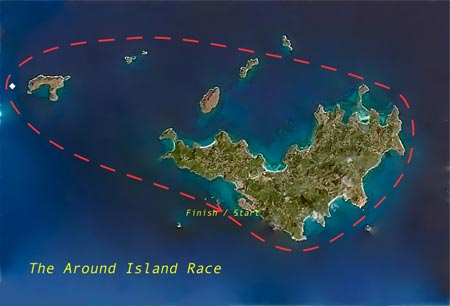
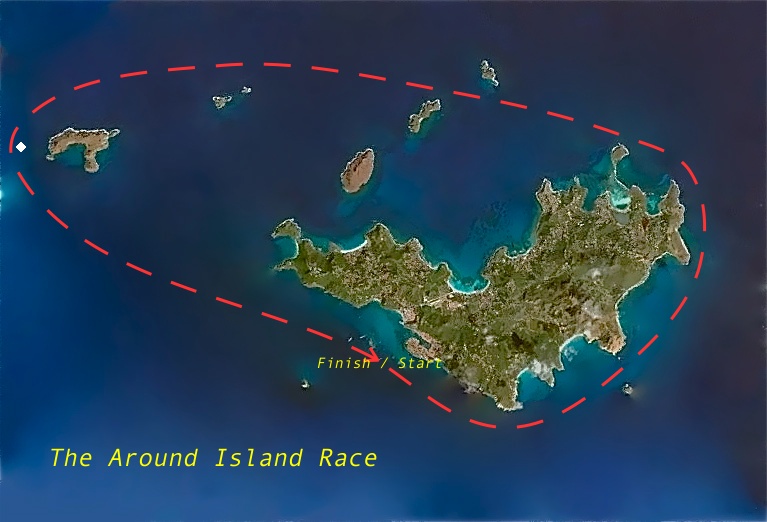
Around the Island Race (Click photo to enlarge)
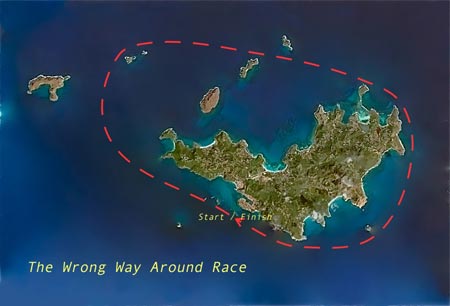
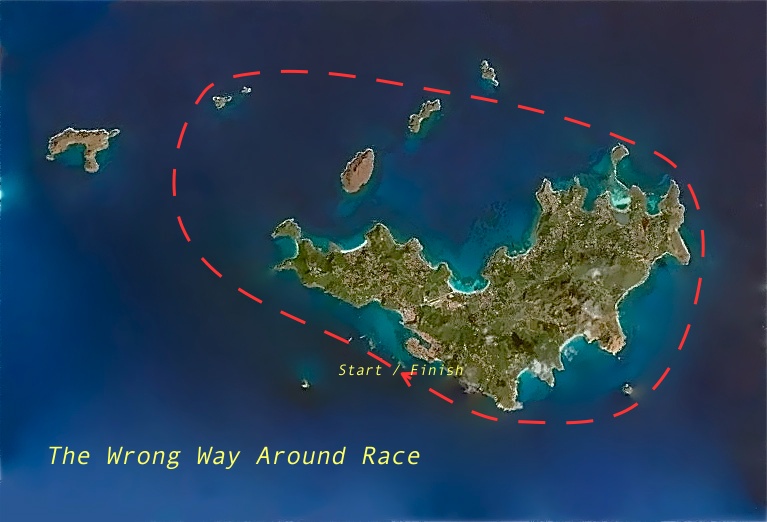
The Wrong Way Around Race (Click photo to enlarge)
Sample Application
Download Bucket Sample Application 2010
|